The Impact of Claude’s Rise on the AI Industry
Claude’s rise is transforming the AI industry from a solo act into a fierce competition. To understand its impact, we need to examine it from three distinct perspectives: market dynamics, technological pathways, and industrial ecology.
Market Dynamics
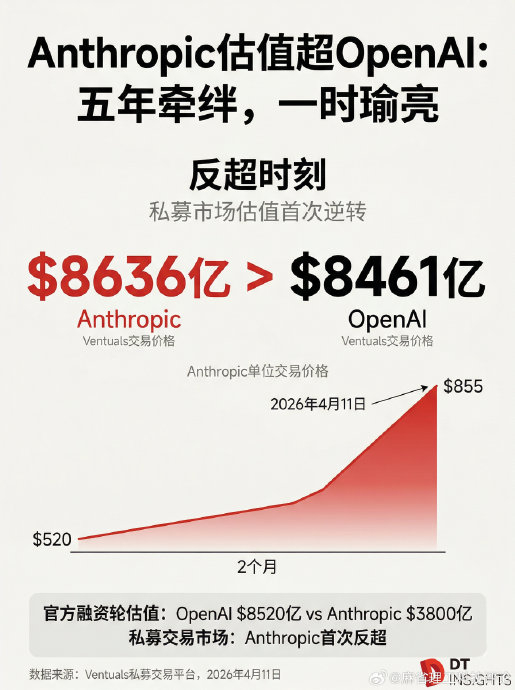
From the perspective of market dynamics, Claude has broken OpenAI’s monopoly, shifting the landscape from a single dominant player to a multi-polar competition. In February 2026, when Anthropic completed its financing, its valuation was $380 billion. Just two months later, its private market valuation soared to between $800 billion and $1 trillion, surpassing OpenAI’s $852 billion. This frenzy in the capital market directly reflects users and enterprises voting with their feet.
Data shows that the uninstallation rate of ChatGPT skyrocketed by 413% in March this year, while Claude’s downloads surged by 199% within a week. This back-and-forth indicates a rapid dissolution of competitive barriers. A Stanford HAI report noted that by 2026, the performance gap between top models had narrowed to just 2.7%, eliminating the absolute technological advantage.

Technological Pathways
Regarding technological pathways, Claude’s rise signifies a shift in the industry from a “scale competition” to a new phase that emphasizes both efficiency and safety. Anthropic chose not to stubbornly pursue parameter scaling but instead explored a “third way” through precise innovation. Its core technology, Constitutional AI, encodes human values into the model’s internal logic, fundamentally enhancing the credibility and traceability of outputs, which has earned Claude unique trust in high-risk fields such as finance and law.
At the architectural level, optimizations like the circular Transformer have reduced the computational cost of processing long texts to a fraction of traditional methods, achieving higher performance with less computational power. This directly challenges the past Scaling principle of “more power equals better results,” forcing the entire industry to rethink whether there are smarter approaches beyond merely increasing model size.
Domestic manufacturers, including Kimi, have quickly followed suit with similar efficiency optimization strategies.
Industrial Ecology
In terms of industrial ecology, Claude’s rise is reshaping the way enterprise services and developer ecosystems operate, accelerating AI’s industrial implementation. Anthropic’s strategy is clear: abandon the consumer market tussle with OpenAI and focus on the high-value enterprise market. This strategy has proven effective, with the number of enterprise clients paying over $1 million annually doubling from 500 to 1,000 in just two months, covering eight of the top ten global wealth companies.
Among enterprises that are purchasing AI services for the first time, Anthropic boasts a win rate of 70%. The key to its success lies in ecological compatibility: Claude is the only leading model embedded in AWS, Google Cloud, and Microsoft Azure, allowing enterprises to seamlessly integrate without altering their existing IT architecture. On the developer side, Claude has fostered an active agent ecosystem.
For instance, the champion project “Everything Claude Code” on GitHub has over 140K stars and integrates 48 agents for production environments, upgrading AI from a conversational tool to a collaborative operating system.
Conclusion
In summary, Claude’s rise is not merely a “second-place comeback”; it is reconstructing the rules of the AI industry from three dimensions.
First, the competitive landscape has shifted from a “single pole” to a “multi-pole” structure. The market is no longer dominated by OpenAI alone but features a landscape where OpenAI, Anthropic, Google Gemini, and Chinese manufacturers all compete, with the focus shifting from model capabilities to ecological collaboration and scenario implementation.
Second, the technological paradigm has transitioned from “brute force miracles” to “precise innovation”. Claude demonstrates that through architectural optimization and alignment technology innovation, it is possible to achieve safer and more efficient AI without blindly pursuing parameter scale, providing a new model for technological evolution in the industry.
Finally, the industry focus has shifted from “technology demonstration” to “value creation”. By deeply integrating with enterprise workflows, building a multi-cloud compatible ecosystem, and empowering the developer community, Claude has transformed AI from a flashy demonstration into an enterprise-level tool that directly enhances productivity and generates tangible returns.
Claude’s story tells us that in the next phase of the AI industry, the winner may not necessarily be the fastest runner but rather the one who understands the game best and is deeply rooted in the field.
Comments
Discussion is powered by Giscus (GitHub Discussions). Add
repo,repoID,category, andcategoryIDunder[params.comments.giscus]inhugo.tomlusing the values from the Giscus setup tool.