The AI Programming Landscape
The AI programming arena is valued at hundreds of billions of dollars, with three main players: Challenger Cursor, leveraging its “global code understanding”; Defender GitHub Copilot, backed by Microsoft’s vast ecosystem; and Disruptor Claude Code, aiming to redefine the rules with its powerful foundational model.
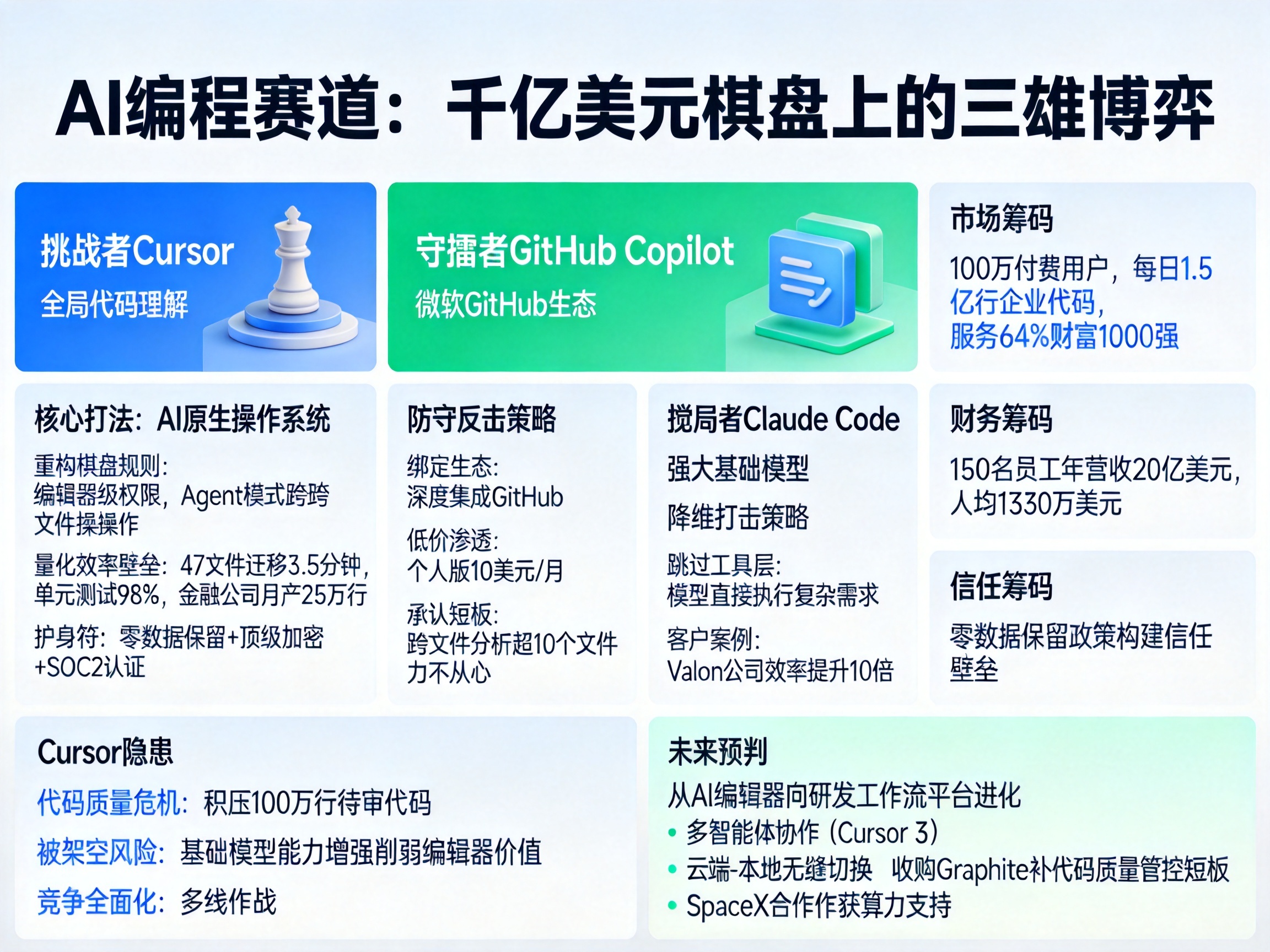
Cursor’s rise is essentially a precise “flanking attack”. Instead of directly competing with Copilot’s strength in “single-line code completion,” it has focused on its opponent’s weakness—large-scale, cross-file code management.
Cursor’s Strategy: Targeting Enterprise Needs
Cursor’s core strategy is to elevate itself from a mere “plugin” to an “AI-native operating system”. This is not just a rephrasing but a fundamental shift in strategic intent.
-
First Move: Redefining the Rules. While Copilot operates as a plugin, limited to the currently open file, Cursor has completely redesigned an editor. This grants it “autonomous driving” level permissions—its Agent mode can automatically read, analyze, and modify any file in a project, even executing terminal commands. The intent is clear: bypass all limitations and give AI a global view of the project.
-
Second Move: Quantifying Efficiency Barriers. The metrics must be substantial. In practical tests, Cursor migrated the logging system of 47 Python files in just 3.5 minutes, achieving a 98% unit test pass rate. After implementation in a financial firm, monthly code output skyrocketed from 25,000 lines to 250,000 lines. These are not mere adjectives but efficiency data that CIOs understand.
-
Third Move: Offering a “Protective Charm.” Large enterprises are primarily concerned about code privacy. Cursor’s enterprise version promises zero data retention, backed by top-tier encryption and SOC 2 certification, ensuring that customer code is not used to train models. This move has alleviated the last security concerns of Fortune 500 companies, leading 67% of them to become clients.
Competitors’ Countermeasures and Real Pressures on Cursor
In response to Cursor’s surprise attack, other players are adjusting their strategies.
GitHub Copilot’s strategy is “defensive counterattack”: It does not aim to surpass in specific functionalities but rather to build a moat through its ecosystem and pricing. Its strategy includes:
- Binding the Ecosystem: Deep integration with GitHub, making open-source projects and team collaboration reliant on it.
- Low-Cost Penetration: The personal version is only $10/month, using affordability to counter Cursor’s $20 price.
- Acknowledging Shortcomings: Performance assessments show Copilot struggles with cross-file analysis, becoming ineffective with more than 10 files. Its intent is clear: maintain its base and use scale and stickiness to hold off competitors.
Claude Code’s strategy is “dimensionality reduction”: As a model provider, it is not satisfied with being an “assistant” but aims to become an “executor.” Its approach is more direct: if the model is strong enough, why is a complex editor layer necessary? Some enterprise clients, like Valon, have reported a tenfold increase in efficiency after switching to Claude Code. This move aims to bypass the tool layer and directly challenge the foundational logic of Cursor.
Current Landscape: Who Holds the Advantage?
Looking at the chips on the table, Cursor indeed holds a strong hand:
- Market Position: Over 1 million paying users, generating 150 million lines of enterprise code daily, serving 64% of Fortune 1000 companies.
- Financial Metrics: With 150 employees generating $2 billion in annual revenue, Cursor boasts a per capita output of $13.3 million, eight times that of tech giants.
- Trust Factor: The “zero data retention” policy has built a high trust barrier in the enterprise market.
However, the game is far from over, and Cursor faces significant risks:
- Code Quality Crisis: The surge in AI-generated code has led to immense review pressure, with a backlog of 1 million lines of code awaiting review. This is a ticking time bomb in its rapid growth model.
- Risk of Being “Undermined”: If future foundational models (like Claude or GPT) become strong enough to directly understand complex requirements and execute them, Cursor’s value as an “enhanced editor” may diminish. This is the threat posed by Claude Code.
- Comprehensive Competition: Beyond Copilot and Claude Code, Amazon CodeWhisperer is eroding the cloud-native market with a free strategy, while open-source solution CodeLlama appeals to privacy-sensitive clients. The battlefield is shifting from a single dimension to a multi-front war.
Future Predictions: How Should Cursor Solidify Its Lead?
The next likely move for Cursor is to accelerate its evolution from the “strongest AI editor” to an “AI development workflow platform”.
It has already launched features like multi-agent collaboration (Cursor 3) and seamless cloud-local switching. The aim is to upgrade the efficiency tool for individual developers into the foundational operating system for team and enterprise development processes. Additionally, acquiring the code review company Graphite addresses the critical shortcoming of “code quality control”.
If a partnership or acquisition with SpaceX is achieved, Cursor could gain unprecedented computational power, potentially widening the gap with pure software companies.
The conclusion is clear: currently, Cursor has achieved significant leadership in the enterprise high-end market through its engineering advantages built on cross-file analysis. However, its lead is structural, not overwhelming. It has found a high-value strategic gap between Copilot and Claude Code using its “global view” and “absolute security”.
Nonetheless, it is simultaneously under pressure from both ends (foundational model providers and low-cost tools) and must address the “code flood” issue it has created. The outcome of this game will not depend on the superiority of specific technologies but on who can first define and control the complete workflow of the next generation of software production.
Comments
Discussion is powered by Giscus (GitHub Discussions). Add
repo,repoID,category, andcategoryIDunder[params.comments.giscus]inhugo.tomlusing the values from the Giscus setup tool.